Heat Pump Water Heaters: Worth It in the Bay Area?
Heat pump water heaters are the most efficient option on the market right now. They pull heat from the surrounding air and transfer it into a storage tank — using a fraction of the energy that gas or standard electric units need.
With the 2027 Bay Area gas water heater phase-out approaching and generous federal and state rebates still available, more Bay Area homeowners are asking whether a heat pump makes sense for their home.
The honest answer: for some homes, absolutely. For others, a tankless water heater is still the better fit. Here's how to tell.
How Heat Pump Water Heaters Work
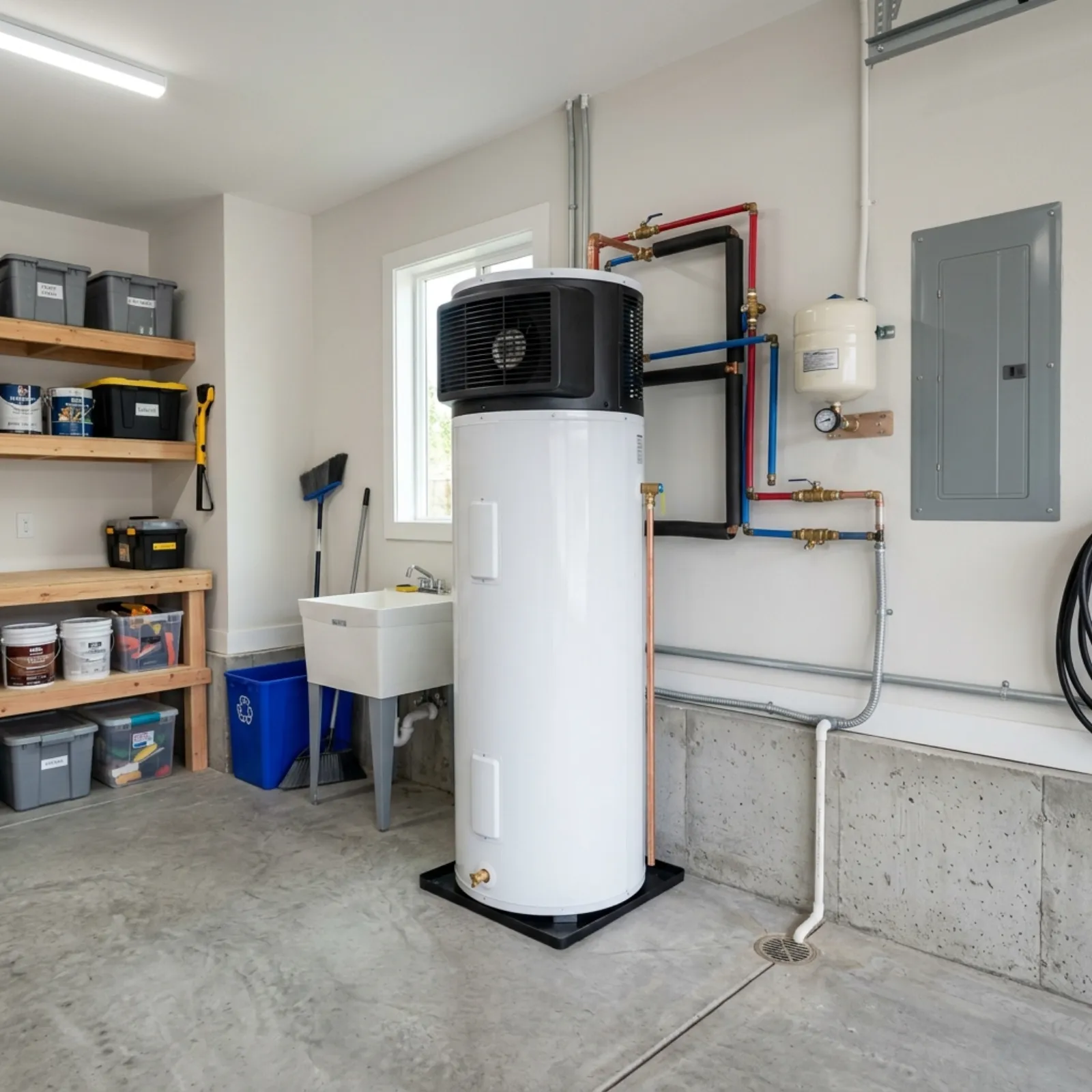
Think of it like a refrigerator running backwards. Your fridge pulls heat out of the box and dumps it into the kitchen. A heat pump water heater does the opposite — grabs heat from the garage air and moves it into the water tank.
The compressor and fan on top do the heavy lifting. Because they're moving heat rather than generating it, they use far less energy.
The efficiency numbers are real. A gas tank water heater runs at about 80% efficiency. A heat pump runs at 300 to 400% (measured as a Coefficient of Performance, or COP). That translates to roughly $200 to $400 in annual energy savings depending on your usage and utility rates.
Cost and Rebate Breakdown
| Heat Pump | Gas Tank | Gas Tankless | |
|---|---|---|---|
| Unit cost | $1,800 to $3,500 | $800 to $1,500 | $1,500 to $3,500 |
| Installation | $1,500 to $3,000 | $500 to $1,000 | $1,500 to $3,000 |
| Total before rebates | $3,300 to $6,500 | $1,300 to $2,500 | $3,000 to $6,500 |
| Federal tax credit | Up to $2,000 | None | None |
| CA TECH rebate | $1,000 to $3,000 | None | None |
| Net cost after rebates | $300 to $3,500 | $1,300 to $2,500 | $3,000 to $6,500 |
The rebate landscape changes frequently. We wrote a full breakdown of current rebate stacking strategies including HEEHRA, TECH Clean California, BayREN, and the federal 25C tax credit.
After rebates, a heat pump can cost less out of pocket than a gas tank replacement.
Where Heat Pumps Work Best
Heat pumps need three things most San Francisco homes don't always have:
Space. These units are large. A 50-gallon heat pump stands about 6 feet tall and needs at least 700 cubic feet of surrounding air to operate efficiently. A garage works well. A tight utility closet does not.
Warm air. Heat pumps extract heat from ambient air. They work in the Bay Area's mild climate, but they're less efficient in cold, enclosed spaces. A garage that stays above 50°F year-round is ideal.
A 240V electrical circuit. Most gas water heaters only need a standard 120V outlet (or no electricity at all). Heat pumps require a dedicated 240V, 30-amp circuit. If your electrical panel is already at capacity, adding this circuit may require a panel upgrade ($2,000 to $4,000).
Where They Don't
Small closets and interior rooms. If your current water heater sits in a hallway closet or a small interior utility room, a heat pump won't fit or won't have enough airflow. In neighborhoods like the Sunset and the Richmond where water heaters are often tucked into tight spaces, this is the most common disqualifier.
Noise-sensitive locations. The compressor on a heat pump produces a low hum, similar to a dehumidifier. It's not loud, but it's noticeable if the unit is near a bedroom or living space.
High simultaneous demand. Heat pumps have a slower recovery rate than gas. If your household routinely runs two showers, a dishwasher, and a washing machine at the same time, a heat pump may struggle to keep up without a larger tank (65 to 80 gallons).
Which Models Do We Install?
| Model | Capacity | Best For |
|---|---|---|
| Rheem ProTerra | 40, 50, 65, 80 gal | Most popular. Strong app integration, quiet operation. |
| A.O. Smith Voltex | 50, 66, 80 gal | Reliable. Good parts availability. |
| Rheem Performance Platinum | 40, 50 gal | Budget-friendly heat pump option. |
The Rheem ProTerra is our most-installed heat pump unit. The 50-gallon handles most 2 to 3 person households. Larger families or homes with radiant heating should consider the 65 or 80-gallon version.
Heat Pump vs Tankless: Which Should You Choose?
This is the question we answer most. Here's the quick version:
Choose a heat pump if: you have garage space, want the lowest operating cost, plan to stay in the home long-term, and can take advantage of rebates.
Choose tankless if: space is tight, you want endless hot water on demand, your gas infrastructure is already in good shape, or you're in a home where electrical upgrades would be expensive.
The right one depends on your home's layout, electrical capacity, and priorities.
Common Questions
How long do heat pump water heaters last?
12 to 15 years with proper maintenance. The tank itself has the same corrosion timeline as any storage water heater.
Are heat pump water heaters loud?
They produce about 50 to 55 decibels during operation, similar to a conversation or a running dishwasher. In a garage, you won't notice it. Next to a bedroom wall, you will.
Do heat pump water heaters work in cold weather?
Yes, but less efficiently. Below 40°F, most models switch to standard electric resistance heating as a backup, which uses more energy. Bay Area garages rarely drop below 50°F, so this is seldom an issue here.
Can I replace my gas water heater with a heat pump myself?
We don't recommend it. The installation involves plumbing, electrical work (240V circuit), and condensate drainage. Rebate eligibility also typically requires a licensed contractor.
Want to know if a heat pump makes sense for your home? We'll check your space, electrical panel, and rebate eligibility. (415) 623-6564