Navien Error Codes: What They Mean in the Field
Table of Contents
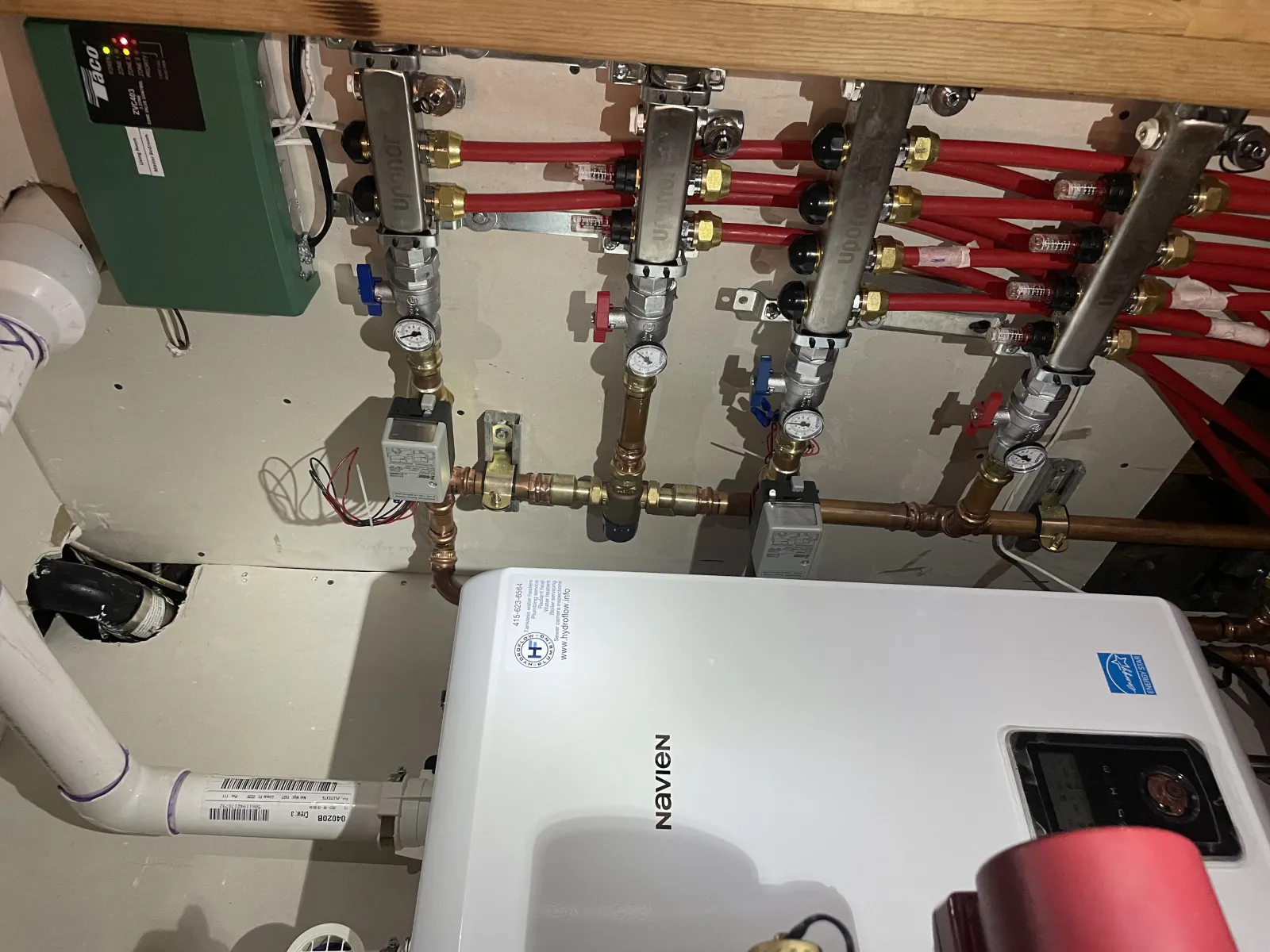
Navien makes solid equipment. We install their NPE and NCB units regularly in San Francisco homes and have for years. But like any complex appliance, they throw error codes. Some are harmless. Some need immediate attention.
Here are the codes we see most often on service calls and what they actually mean when a tech is standing in front of the unit.
E001: Ignition Failure
This is the most common Navien call we get. The unit tries to light, fails three times, and locks out.
What causes it: Usually a gas supply issue, not a bad ignitor. In San Francisco, we see this frequently after PG&E does work on the street. Gas pressure drops just enough that the unit can’t light. Other causes include a dirty flame rod, a clogged condensate trap blocking the exhaust, or a vent termination too close to a dryer vent that’s blowing lint into the intake.
What to do: Check if other gas appliances are working. If your stove lights fine, the issue is likely at the unit. Power-cycle it once. If E001 comes back, call a tech. Do not keep resetting it repeatedly.
E012: Flame Loss
The unit lights but loses flame during operation. Different from E001 because it successfully ignites first.
What causes it: Wind blowing into the vent termination is the most common cause in the Richmond and Sunset districts where we get heavy ocean winds. Also caused by a dirty or failing flame rod, fluctuating gas pressure, or a partially blocked condensate drain.
What to do: If it happens once on a windy day, power-cycle and monitor. If it keeps happening, the flame rod likely needs cleaning or replacing. It is a quick fix for a tech but not a DIY job because you need to access the combustion chamber.
E016: Overheating
The unit’s internal temperature exceeded safe limits and shut down.
What causes it: Scale buildup inside the heat exchanger is the primary cause. San Francisco has moderately hard water, and tankless units concentrate minerals faster than tank heaters because the water moves through a small exchanger at high temperature. We also see this when the recirculation pump runs too aggressively without a timer.
What to do: Do not ignore this one. Repeated overheating damages the heat exchanger permanently. Call a tech. The unit likely needs a descaling flush, and if it has been overheating for months, the exchanger may need inspection.
E110: Exhaust Blocked
The unit detects insufficient airflow through the venting system.
What causes it: In Victorian and Edwardian homes with long vent runs through walls and up through floors, this happens when the vent terminates too close to an obstruction, when a bird or debris blocks the termination, or when the installer used too many elbows in the vent run. We have also seen it triggered by construction dust when nearby renovation work pulls debris into the intake.
What to do: Go outside and check the vent termination. Clear any visible obstructions. If the termination is clear, the issue may be internal, either a failed pressure switch or a vent run that was always marginal. A tech needs to measure the static pressure.
E515: Low Water Flow
The unit is not getting enough water flow to fire.
What causes it: San Francisco’s older homes frequently have undersized water lines, especially galvanized supply lines that have corroded internally over decades. The pipe looks fine on the outside but the inside diameter is reduced to a fraction of its original size. We also see this with inlet filter screens clogged with debris, especially after city water main work.
What to do: Check the cold water inlet filter screen. It is a small screen at the cold water connection on the bottom of the unit. You can clean it yourself if you are comfortable shutting off the water supply. If the screen is clean and the code persists, you likely have a flow rate issue that requires a plumber to diagnose.
E302: Remote Controller Communication
The unit and the remote control panel cannot communicate.
What causes it: A loose wire at the control board, a damaged cable between the unit and the remote, or a failed remote panel. In retrofits where the remote is mounted far from the unit, we sometimes find that the installer spliced the communication wire and the splice corroded.
What to do: Check that the remote panel has power. If the display is blank, it may just be a wiring connection. If the display shows the error, power-cycle the unit. Persistent E302 usually means a tech needs to check the wiring or replace the remote.
E594: Condensate Blockage
The condensate drain is blocked, preventing the acidic condensate water from draining properly.
What causes it: Navien condensing units produce acidic condensate that must drain to a neutralizer or floor drain. In basement installations, the drain line can freeze in cold weather, clog with mineral deposits, or develop biofilm that restricts flow. We see this more in units installed without a proper condensate neutralizer.
What to do: Check the condensate drain line for kinks, blockages, or ice. If the neutralizer is full of calcium, it needs to be refilled or replaced. This one is worth calling a tech for because improper condensate drainage can corrode the heat exchanger.
When to Reset vs. When to Call
Safe to reset once and monitor:
- E001 after a power outage or PG&E work
- E012 on a single windy day
- E302 after bumping the remote panel
Call a tech:
- Any code that comes back after a single reset
- E016 (overheating) even once
- E515 if cleaning the inlet screen does not resolve it
- E594 if you see water pooling under the unit
Annual Maintenance Prevents Most of These
Most of these error codes are preventable with annual maintenance. A standard Navien service call includes flame rod cleaning, condensate system inspection, inlet filter cleaning, a descaling flush, and combustion analysis. We recommend annual service for all tankless units, but especially for Navien NCB combi-boiler units that handle both heating and hot water.
Seeing an error code on your Navien? Call us at (415) 623-6564 or schedule a service call. We service Navien tankless water heaters and combi-boilers across San Francisco, Marin County, and the Bay Area. We are factory-familiar with all current Navien models including the NPE, NCB, and NHB series.
HydroFlow
San Francisco's trusted experts in plumbing, radiant heating, and boiler services. Serving the Bay Area since 2005.